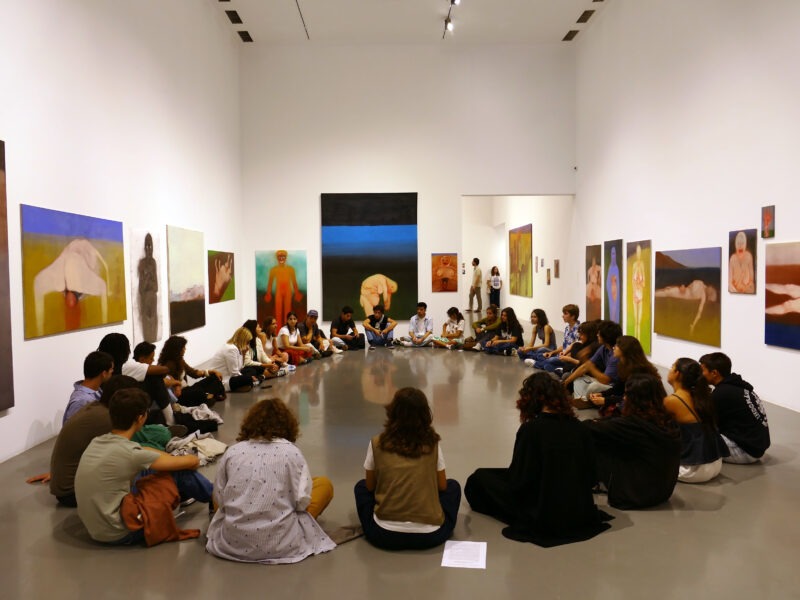
In “Na Borda,” Lia Rodrigues creates a space for gathering and sharing creativity and experiences of the possibilities of other worlds, drawing on her 40-year professional career, which has included the Maré Arts Center, in Rio de Janeiro, the a Escola Livre de Danças da Maré, and an extensive artistic program that continues today to advocate for a world where we can be joyful, loving, inventive, just, and supportive of one another.
“I think we change and grow together. It’s a process that never ends; it simply renews itself.”
Lia Rodrigues
Lia Rodrigues’s dances are woven from that delicate fabric that is the life force of shared vulnerability—a space where wonder and haunting meet, a space unsettled by multiple questions about citizenship, history, how art can conceive of the world, what is considered beautiful, memory, and contemporary art. And so many other questions, some of an aesthetic nature, such as the unusual forms the body produces. Since 1988, the year she began choreographing, she has been exploring these possibilities of other worlds through the dances that bodies embody, in encounters with other artists, thinkers, or… simply people.
In the constant questioning of “What We Are Made Of”—the title of the piece she created in 2000—bodies unfold into multiples of themselves, into various possibilities of being. From collapsing bodies to bodies offering support, including naked bodies, sculptural bodies, impermanent bodies, and so many others. These bodies continue this journey of their multifaceted manifestations in more recent works, where the vitality accumulated over decades reemerges in a sensitive, sensory, and highly visual journey, amidst multi-layered structures that draw us into the world we inhabit and into the responsibility of collaborating in the creation of other possible worlds, as we saw just this year in Lisbon and Porto with “Borda,” her latest creation.
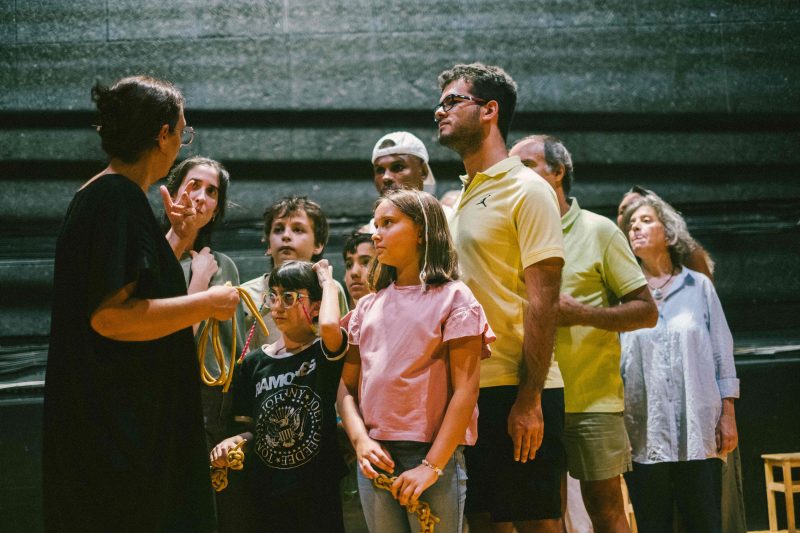
In this workshop led by Lia Rodrigues, the invitation is for an encounter among arts professionals—from any artistic field, at any level of specialization, in theory and practice—who wish to forge a path other than that of mere utility. Over the course of these days, she will share—in a theoretical and practical workshop—some of the questions that still haunt her today, in these times of urgency and great turbulence, threats to democracy, violence, and prejudice, in a sharing that activates the capacity to surprise, move, outrage, make us laugh, act, and inform. All of this is dance.
Taking Borda, her latest creation, as one of our points of reference, we will explore concepts such as borders, margins, who belongs and who does not, seeking to invent together new forms and spaces of existence, pursuing that horizon, which was written many years ago in a note in a notebook—the author’s name of which was not recorded—and which reads: “I still believe there can be a world in which we can be joyful, loving, and inventive, while maintaining a sense of justice and solidarity toward others.”
Destinatários: profissionais das artes – de qualquer área artística, em qualquer grau de especialização, da teoria e da prática – que queiram trilhar um outro caminho, que não o da mera utilidade.
Lotação: 20 participantes
Inscrição: As inscrições podem ser efetuadas através do preenchimento do formulário de inscrição.
Política de reembolso: Apenas serão aceites pedidos de reembolso efetuados até ao dia 23.09.2026. Os pedidos deverão ser feitos pelo email comunicacao@bocabienal.org
Biography
Lia Rodrigues was born in 1956 in São Paulo. She studied classical ballet and history at the University of São Paulo (USP). In the 1970s, she was involved in the contemporary dance movement and was a member of the Maguy Marin Dance Company from 1980 to 1982. Upon returning to Brazil, she founded the Lia Rodrigues Dance Company in 1990 in Rio de Janeiro, offering year-round activities, dance workshops, new productions, classes, and rehearsals. In 1992, she created and directed the Panorama Festival—Rio de Janeiro’s most important dance festival—for 14 years. Since 2004, her company has been conducting educational and artistic activities in the Maré favela in Rio de Janeiro, in partnership with the nongovernmental organization Redes de Desenvolvimento da Maré. In 2009, she opened the Maré Arts Center, and in 2011, the Maré Free School of Dance. Throughout her 40-year professional and artistic career, choreographer Lia Rodrigues has dedicated herself not only to training and artistic creation—with tours and commissions from major capitals around the world—but also to education, through workshops and seminars in various countries. Blending activism and utopian ideals, she believes in the synergy between art and social processes. In 2022, she was honored by the French government with the medal of Officier de l’Ordre des Arts et des Lettres. Among her notable works are Formas Breves (2002), Incarnat (2005), Chantiers Poétiques (2008), Pororoca (2009), Piracema (2011), Pindorama (2013), Para que o céu não caia (2016), Fúria (2018), and Encantado (2021).